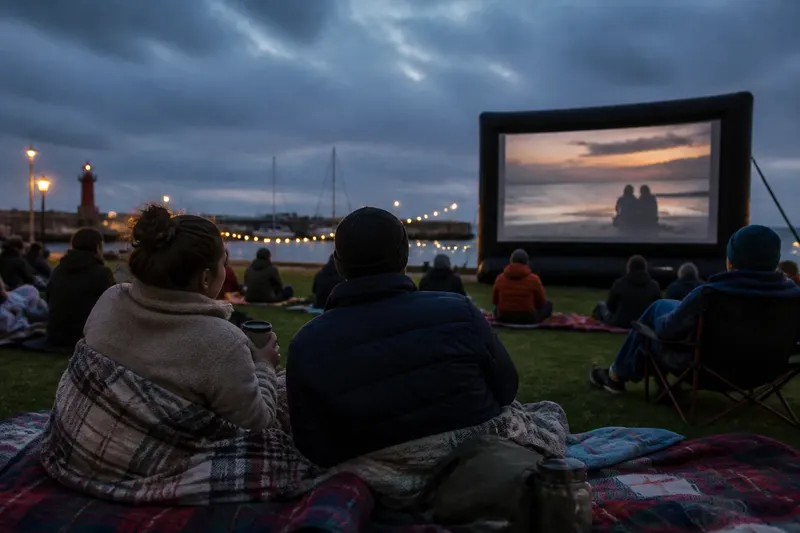
From Travelling Show to Seaside Screen: A Short History of Coastal Filmgoing
Coastal filmgoing moved from temporary shows to settled venues, changing where people gathered and how a local screening could become part of ordinary life.
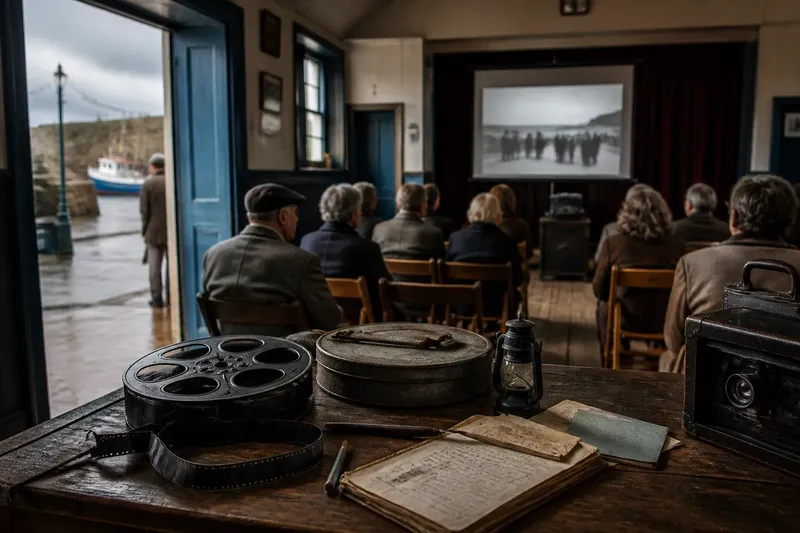
The common mistake in describing coastal filmgoing is to assume every town’s story led neatly from a visiting show to a permanent cinema. The shift from travelling film shows to settled seaside screens was uneven: a screen might arrive for an occasion, share space in a hall or become part of a venue’s regular programme.
What did a travelling film show bring to the coast?
A travelling film show brought its programme and equipment to a place where a room or open space could host an audience. Depending on local arrangements, screenings might take place in a public hall, an assembly room or a fairground. The show was an event to arrange and announce, not necessarily a standing option on the town’s calendar.
Each visit depended on practical cooperation: someone had to arrange a venue, prepare a screen or suitable surface and let people know when to attend. Shared spaces could host other activities as well, but that flexibility came with a trade-off. Films were available when a show could be arranged, rather than whenever a local audience wished to see them.
Coastal places also differed in their rhythms. A resort, a working harbour town and a smaller settlement did not have the same visitors, venues or local organisations. It is safer to ask how a particular place arranged screenings than to assume one pattern applied along the whole coast.
How did settled venues change coastal filmgoing?
A fixed cinema gave filmgoing a continuing local address. An operator could offer a recurring programme, and residents could become familiar with where screenings took place. That made a visit easier to plan, though it did not make attendance automatic.
A permanent venue still depended on its operator, programme and audience. Its position mattered: a cinema near a town centre, promenade or transport stop offered a different route from one on the edge of a settlement. Scheduling, admission arrangements and film choices also shaped who felt able to attend.
A settled screen could become a familiar social setting for relatives, friends or neighbours. But regularity is not the same as universal access. A continuing venue might suit some groups better than others, depending on where it stood and how it operated.
What kinds of buildings hosted films?
Some venues were designed for cinema; others used rooms built for different purposes. A hall might host screenings alongside meetings or other entertainment, while a dedicated cinema made filmgoing a more visible part of local leisure. Coastal filmgoing did not follow a simple route from temporary tent to purpose-built picture house.
Imagine a harbour town where a visiting show uses the community hall during a holiday week. The organiser leaves, and a local operator later arranges a recurring programme in that same hall. Residents can now plan around a familiar place and a known screening schedule, though the hall still has to accommodate its other uses. The change lies in the local arrangement, not in any claim that one kind of venue is automatically better.
What did regular screenings change about gathering?
A one-off show draws people around a particular visit. A continuing programme can fit into ordinary routines: someone might attend after work, meet relatives there or combine a film with a walk along the promenade. Those habits depend on local schedules and geography, not on a universal seaside custom.
Regular screenings could bring together residents, visitors and people attending for different reasons. Sharing a room did not mean sharing the same expectations. A cinema’s audience was a public gathered for a screening, not necessarily a single community in agreement.
How can you investigate a local seaside cinema?
If you are tracing a venue’s history, distinguish what a source establishes from what it merely suggests. A surviving façade may identify a building, but it cannot by itself show how often films were screened or who attended. Local directories, maps, photographs, listings and community recollections can help build a more careful account.
- Check a directory for a cinema listing; if it names a venue, look for corroborating evidence of its use, but if it does not, check other records before concluding that no screenings took place.
- Compare maps with the building’s location; if it appears near a town centre or promenade, describe that position, but if the map is unclear, avoid claims about how convenient it was to reach.
- Look at dated photographs for signs of a dedicated entrance or shared premises; if the image supports one interpretation, present it as evidence of the building’s appearance, but if it does not, seek a written record of its use.
- Search local listings for screening notices; if notices name dates or programmes, report only what they state, but if listings are absent, do not treat silence as proof that screenings never happened.
- Compare records mentioning meetings, performances or other events; if the same venue hosted several activities, describe it as shared, but if the records show only film use, keep the claim within that evidence.
- Ask community groups about recollections and their provenance; if someone identifies a memory as personal or inherited, attribute it accordingly, but if the account cannot be traced, label it as unverified recollection.
What questions help separate a visiting show from a regular cinema?
Did every seaside town have a permanent cinema?
No single pattern should be assumed for every town. A place might have had a dedicated venue, relied on shared spaces or hosted occasional visiting shows; local records are needed to tell which arrangement applied.
Were travelling shows simply temporary substitutes?
They were a way of showing films in their own right, rather than merely an unfinished version of a cinema. Their availability depended on a visit being arranged, while a settled venue could offer a continuing local programme.
Did a permanent cinema serve residents and visitors equally?
Not necessarily. Location, schedules, admission arrangements and programming could affect different people in different ways, so the label “seaside cinema” alone says little about access.
How can I tell whether a building was dedicated to films?
Compare directories, listings, photographs, maps and records of other events. A façade can offer clues, but evidence of how the building was used is needed before describing it as a dedicated cinema or a shared venue.
What is not worth forcing into the story?
It is not worth sorting every old hall, pavilion or resort room into a confident category when the evidence is thin. Temporary screenings and settled venues could coexist, and a cautious description is more useful than an unsupported claim about frequency or attendance.
The useful distinction in coastal filmgoing is between a screen that visited and one people could expect to find locally again. When writing about a particular place, state what the records show, identify what remains uncertain and resist turning a varied local history into a tidy march towards the permanent cinema.