The Postcard Coast on Screen: Why a Pretty View Is Not a Whole Place
The postcard coast on screen can make a shoreline look complete. Notice what the camera excludes, and watch coastal communities with sharper attention.
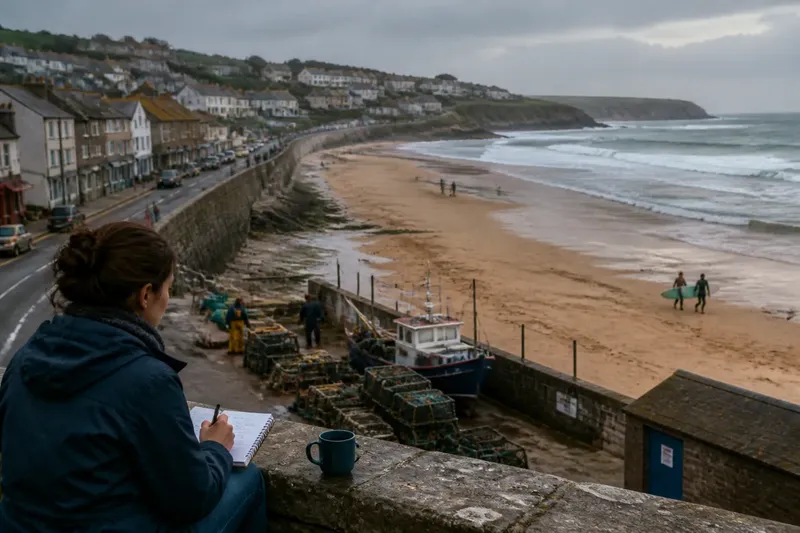
The postcard coast on screen often arrives in a clean sweep: pale sand, a bright strip of sea, perhaps a small boat placed where it can be admired. The common mistake is to treat that view as a portrait of the place. It costs the community its ordinary complexity, and it leaves the viewer with scenery where people ought to be.
A film does not need to show everything. Framing is part of its craft, and a beautiful view may carry genuine feeling. The useful habit is not to distrust attractive images, but to ask what they can tell you, what they cannot, and whose lives have been kept beyond the frame. A week of attentive viewing is enough to make that habit more concrete.
What does the postcard coast leave outside the frame?
Start with the image itself. A coast on screen may appear as a leisure setting, a romantic refuge or a stage for personal reinvention. Those meanings can be persuasive precisely because the shot has been pared down. A camera can exclude a working harbour, a road, a housing estate, a seawall, a tide warning or the people who keep a visitor-facing town running.
None of those absences automatically makes a film dishonest. A story has limited time and a particular point of view. The question is whether a viewer mistakes one chosen angle for a complete account. A town seen through a holidaymaker’s eyes may feel quite different from the same place seen by someone who lives there, works there or cannot afford to treat it as a view.
Try separating three things while you watch: what the film shows, what it implies, and what it leaves uncertain. The distinction is modest, but it stops a familiar beach from doing the work of an entire community.
How can you watch one coastal film over a week?
Choose one film with a recognisable coastal setting. It need not be set in a named real town; the point is to pay close attention to how the shoreline functions in the story. Use a notebook or a few lines in your phone, and spread the viewing across a week rather than turning it into an exercise in catching mistakes.
- On the first evening, watch without pausing. Note the broad impression the coast creates: escape, work, danger, beauty, boredom, belonging, or something less tidy. Write down one image that stays with you, not a verdict on whether the place seems realistic.
- On the next day, look at the edges of the frame. Notice roads, buildings, fences, harbour structures, signs, shops and other traces of daily life. Ask what the composition draws your eye towards and what it makes easy to overlook.
- Midweek, listen rather than watch. Pay attention to accents, background noise, music, wind and the sounds of work or recreation. Notice whether the coast is allowed its own ordinary noise, or is turned into a quiet backdrop for a character’s feelings.
- Later in the week, follow who gets to use the shore. Look for people at work, people visiting, residents, children, older people and anyone whose presence is only briefly acknowledged. The absence of a group is a question to keep open, not evidence of what the community is like.
- On the final evening, write a short second impression. Name one thing the film represents clearly and one thing it cannot tell you. Keep the two notes side by side; the point is to hold both, not to replace admiration with suspicion.
Keep the notes descriptive. “The camera returns to the empty beach” is more useful than “the film ignores local people” if the latter cannot be supported by what you have seen. Close attention is not a licence to invent an explanation for every cut.
Which details make a setting feel lived in?
Look for details that place the shoreline inside a system of ordinary use. A harbour is not simply a photogenic arrangement of boats; it may be a workplace, a route through town, a place of maintenance or a boundary between public and restricted space. A promenade might be for walking, selling, meeting, waiting or getting somewhere else. The same place can serve several purposes, sometimes at once.
Notice how the film handles access. Can characters reach the water freely, or do paths, gates and private boundaries shape their movement? Are there signs of the weather affecting plans, clothes, buildings or transport? Does anyone maintain the place, clear it, sell food, repair equipment or keep watch? Such details do not need explanatory dialogue to matter. A few background choices can make a coast feel inhabited rather than arranged for a camera.
Pay attention to time, too. Some scenes show a shoreline as though it were permanently calm, available and empty. Others suggest changing weather, a working day, a busy season or the quieter stretches between visitors. A film may be compressing events for dramatic reasons, so treat those clues as part of its design rather than as a calendar of local life.
What should you ask after the credits?
Once the viewing is over, use a few questions to test your first impression. They are not a scoring system. Their purpose is to identify what the film makes vivid and where its view becomes narrow.
Who has a reason to be at the shore?
List the characters who visit, live near or work beside the water. If nearly everyone is there for leisure or a personal turning point, notice that pattern without assuming the film had an obligation to include every occupation.
Who explains what the place means?
Listen for who gets to describe the coast, its history or its problems. A setting can be present throughout a film while local voices remain incidental, or while a newcomer is given the most authoritative account.
What does the camera treat as ordinary?
Notice whether everyday infrastructure appears as part of the place or disappears behind scenic views. A road, a shopfront or a harbour wall may tell you how people move through the setting, even if the film gives it no dramatic close-up.
What remains unknowable from this film?
Be specific: perhaps you cannot tell how residents feel about visitors, who owns a stretch of shore or how the town changes outside the season shown. Naming a limit is more accurate than filling it with a plausible-sounding guess.
How can you avoid turning observation into a verdict?
It is easy to swing from accepting the postcard to prosecuting it. A film that favours sweeping views may still contain a careful performance, a sharp sense of weather or an affecting relationship between a character and the shore. Conversely, a few visible shop signs and local accents do not make a film a full account of coastal life.
Imagine you watch a fictional film set in a small harbour town. It repeatedly cuts from a visitor walking along the beach to a sunset over the boats, while a local character appears only to give directions. You note that visitors receive the clearest emotional journey and that the harbour is mostly scenery. You can then say the film centres a visitor’s experience without claiming that the real town has no working harbour life or that every resident is unseen. The first observation belongs to the film; the second would need knowledge the film does not supply.
That distinction also helps when comparing films. Two productions may use the same kind of coastline for entirely different purposes: one may make distance feel liberating, another may make it feel isolating. Ask what the setting does in each story before deciding whether either one represents a community well.
What is not worth the effort?
There is little value in pausing every scene to identify a coastline, checking every building against a map or treating a fictional detail as a clue to the filmmakers’ intentions. That turns viewing into an amateur inspection and often produces confidence without context. If a specific place matters, a reliable local source can answer factual questions better than a freeze-frame.
Nor does every coastal film need to become a lesson in representation. Sometimes a beach is simply where a conversation happens. The more useful question is whether the film’s choices become the only image of the place you carry away, especially when the view is unusually polished and the people around it are thinly drawn.
How does the postcard coast on screen change what you notice?
The postcard coast on screen becomes more interesting when it is treated as a frame, not a verdict. You can enjoy the sea, the light and the composition while noticing who is present, what daily uses are hinted at and what the story leaves unresolved. Those observations do not make a fictional film responsible for documenting a whole town. They make your own response more exact.
Keep one question for the next coastal film you watch: if the shoreline vanished from the frame, what would the characters still be doing, and who would still be there? The answer may be very little. Or it may reveal that the view was carrying more of the story than the film admitted.